
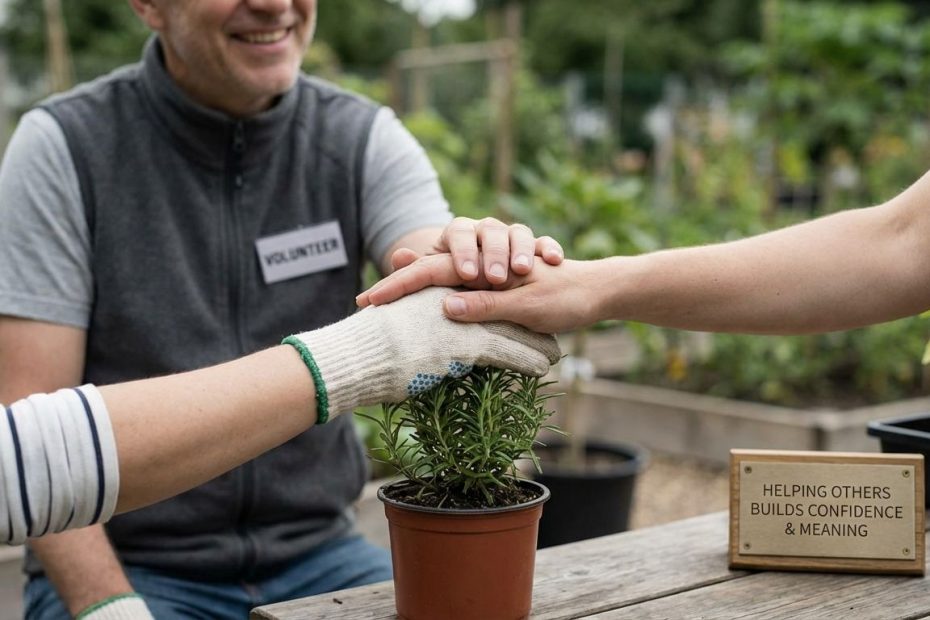
Helping other people improves your life because it forces real-world action: you practice emotional control, communication, consistency, and responsibility in situations where the outcome matters to someone besides you. Done with boundaries, it also lifts well-being, strengthens meaning, and can even track with better health outcomes.
You already know self-development tactics that live in your calendar, the gym, a journal, a course. This one lives in your behavior under pressure. You’ll learn why helping works, what the research actually says, how to do it when time and energy are limited, how to avoid burnout, and how to choose a “helping style” that builds skills you can measure.
Why Does Helping Others Make You Feel Good?
The “good feeling” is not random, and it’s not only sentiment. When you help, attention shifts away from repetitive self-focus and toward a concrete task with a clear finish line. That shift reduces rumination for many people, and it creates a quick win you can point to, which matters when motivation is low.
Research backs up that this isn’t just a nice story people tell themselves. A 2025 meta-analysis in Scientific Reports reviewed 54 effect sizes and found a moderate, statistically significant positive association between compassion for others and overall well-being (reported r = .26). The same paper reports the relationship held across several well-being dimensions, with weaker links to negative affect, and it was not moderated by age, gender, or region. That pattern fits what shows up in real life: helping doesn’t erase hard days, it raises the baseline.
Helping also tends to tighten your feedback loop. You do something, someone benefits, you see proof, and your brain tags the behavior as worthwhile. That loop is a powerful alternative to “self-improvement” that stays trapped in planning and self-evaluation. When your self-development plan keeps turning into self-judgment, service moves you back into output.
The Association for Psychological Science also summarizes research linking kindness to better emotional outcomes and stress buffering, with the simple takeaway that prosocial behavior supports the helper, not only the recipient. This matters when you need a tool that works on days when discipline feels thin. You can still show up for someone else, and that action often pulls your mood with it.
Is Volunteering Actually Good For Your Mental Health, Or Is That Just A Cliché?
Volunteering earns its reputation when it is structured, repeatable, and matched to your capacity. Mental health benefits show up most reliably when helping becomes part of identity and routine, not a one-time burst of effort followed by exhaustion. You don’t need a dramatic story. You need consistency.
Daily-life research supports the “repeatable” angle. A paper in the Journal of Happiness Studies examined prosociality, meaning, and happiness in everyday life and reported that prosocial experiences were associated with increases in meaning, with more modest shifts in happiness. That difference is important for self-development: happiness is volatile, meaning is stabilizing. Meaning is what keeps you returning to the gym, the page, the meeting, the early morning, without negotiating with yourself every time.
From a veteran operator’s view, the strongest mental benefit is role clarity. A good volunteer role has a start time, a finish time, a defined job, and a measurable output. That removes decision fatigue, gives you a social reason to follow through, and builds self-trust. Self-trust is a mental health asset that many “inner work” routines promise, yet service delivers through behavior.
Community discussions often reflect the same practical motivation: people look for actions that pull them out of a loop, build social skills without forced small talk, and create momentum when energy is low. Threads in self-improvement communities repeatedly list volunteering alongside basics like exercise and sleep, not as a moral badge, but as a tactic for building stability and connection.
Does Helping Others Improve Your Physical Health (Blood Pressure, Longevity)?
Helping is not a medical treatment, and no serious practitioner should sell it as one. Yet a growing research trail links volunteering with measurable health indicators, especially when helping is sustained and not chaotic. The most useful way to read this evidence is as “risk support,” not “health guarantee.” When helping increases movement, social connection, and routine, your body often benefits from the secondary effects.
On blood pressure, a recent PubMed-indexed study titled “Reducing Hypertension Through Volunteering?” examined volunteering frequency and blood pressure across groups and reports lower likelihood of clinically high blood pressure among adults who volunteered at higher annual hours (the paper highlights thresholds like 201+ hours/year and analyzes differences by gender, race, and age group). The important operational takeaway is not the exact cutoff, it’s the direction: sustained, meaningful volunteering aligns with better cardiovascular markers for many older adults.
On mortality, an International Journal of Epidemiology study reported an association between volunteering and lower mortality risk (often summarized around a ~25% lower risk versus non-volunteering peers after adjustments, using a partner-controlled design to reduce confounding). That design choice matters because healthier people are more likely to volunteer in the first place, so better studies work harder to separate selection effects from volunteering effects.
Another PubMed-indexed paper, “How is volunteering associated with reduced mortality? A mediator-wide approach,” uses data from the Health and Retirement Study (2006–2018) and tests which pathways may explain the link. That approach is practical: it suggests volunteering may help through mediators that professionals recognize as protective, including social integration and physical health pathways, and that the association appears stronger at sustained annual engagement levels (the paper highlights thresholds like ≥100 hours/year). For your self-development plan, the health angle reinforces a simple rule: build a sustainable helping cadence, not an occasional sprint.
How Does Helping Others Build Confidence, Purpose, And Personal Growth?
Confidence grows when you keep promises and create results. Helping gives you a clean scoreboard: you show up, you contribute, someone is better off, and your actions matter outside your internal narrative. That is confidence that survives a bad week.
Purpose grows when you can connect daily effort to a real outcome. Many people chase purpose by searching for the “right” career, the “right” mission, the “right” calling, then stall because the decision feels permanent. Helping cuts through that. You contribute now, and meaning shows up as a byproduct of useful action. The everyday-life prosociality research linking helping with increased meaning supports this pattern: meaning is responsive to what you do repeatedly, not what you declare once.
Personal growth shows up through skill compression. When you help, you practice high-value skills in a tight loop: listening, explaining, setting expectations, handling frustration, staying calm, documenting, following through, adapting. Most people pay for a course to learn these skills and still struggle to transfer them into real life. A real helping role forces transfer because the environment has stakes.
Workplace evidence also supports the long game. Reporting from UW–Madison on research connected to the Wisconsin Longitudinal Study and General Social Survey highlights that helping others at work, and valuing work that helps others, is associated with greater happiness later in life. That result aligns with what experienced leaders see: service orientation is not only a culture trait, it’s a personal stability strategy. You build a reputation for usefulness, you strengthen relationships, and you create a career path where people trust you with more responsibility.
Helping also pressures you to develop boundaries, which is a serious executive skill. If you cannot say no, you cannot scale. If you cannot set a scope, you cannot deliver. Service becomes the training ground for “yes with constraints,” which is one of the most practical maturity upgrades available.
How Can You Help Others If You’re Busy, Broke, Or Socially Anxious?
Busy is usually a calendar problem, broke is usually a cash problem, anxious is usually an unpredictability problem. Each constraint has a workable helping style, and the best answer is not “do more.” The best answer is “choose a role with low friction and clear edges.”
If time is the constraint, shift your thinking to micro-commitments that still count. A weekly 20–30 minute commitment builds identity and momentum because it is easy to repeat. You can support a community group with scheduling, admin follow-ups, logistics, document cleanup, volunteer onboarding, or resource tracking. Those tasks are not glamorous, which is why they are valuable and often ignored. They also build transferable competence in operations.
If money is the constraint, focus on time and skill, not financial donations. Many organizations need predictable labor more than cash: sorting, organizing, delivering, calling, writing, translating, editing, tutoring, coaching, reviewing resumes, practicing interview skills, or supporting a hotline training path if it fits your capacity. You can also help within your existing job by mentoring a new teammate or improving documentation that reduces errors for everyone.
If social anxiety is the constraint, stop selecting roles that require constant unstructured conversation. Select roles with scripted interactions or behind-the-scenes work. Predictability lowers stress and raises follow-through. You can also set a progression plan: start with low-contact tasks, then move to structured interaction, then move to mentoring when comfort increases. That builds confidence without forcing an abrupt personality rewrite.
Burnout recovery advice in mainstream wellness outlets often includes hobbies and activities that rebuild meaning and connection, and volunteering gets mentioned as part of that mix. The practical value is not the label “volunteering.” It’s the combination of movement, purposeful time, and social contact that is optional yet real. If energy is low, choose short shifts and roles with clear job descriptions.
Can Helping Others Backfire (Burnout, Resentment, Compassion Fatigue), And How Do You Prevent It?
Yes, helping can backfire when it becomes boundaryless, identity-driven, or emotionally chaotic. Burnout and resentment often appear when you take on open-ended responsibility, when you become the default problem-solver, or when you confuse usefulness with self-worth. That pattern is common in workplaces and families, and it is fixable when you treat helping as a professional commitment, not a permanent rescue mission.
Prevention starts with a defined container. Pick a role with clear duties, a clear start time, and a clear end time. If an organization cannot define the job, it cannot protect your energy. If a friend cannot respect a boundary, the help will eventually turn into conflict. Your goal is sustainable contribution, not maximum output.
Operate with three rules that experienced leaders use:
- Scope: Agree on what is included and excluded before you start.
- Cadence: Set how often you help and how long each commitment lasts.
- Exit: Decide in advance how you will step back if capacity changes.
Watch your indicators like a manager watches KPIs. Dread, irritability, sleep disruption, and resentment signal overload. When those signals show up, reduce frequency, switch roles, or move to a lower-intensity commitment. This is not a character test. It is capacity management.
Compassion fatigue risk rises in roles with repeated exposure to intense distress without training, supervision, and recovery time. If that role is necessary and meaningful, select an organization that offers training, debriefing, and peer support. If that structure is missing, pick a different role. A strong helping plan protects your ability to keep helping.
Is Donating Money As Good As Volunteering Time For Happiness?
Donating money can improve happiness, and the effect can be real, measurable, and fast. Volunteering time tends to build a broader self-development return because it adds skills, relationships, routine, and identity. The best choice depends on what you need right now: quick emotional lift, or compounding personal growth.
A well-known experiment published in Science (“Spending money on others promotes happiness”) found that participants assigned to spend money on others reported greater happiness than those assigned to spend money on themselves. That finding is useful when time is scarce: a targeted act of prosocial spending can still move your mood in the right direction.
Replication work adds a reality check. A later paper (“Prosocial spending encourages happiness: A replication…”) reports mixed results depending on measurement choices and analytic decisions, which is typical when psychology findings meet replication attempts. That does not cancel the idea. It means prosocial spending is not automatic. The effect is more reliable when the giving feels voluntary, the impact is visible, and the spending aligns with your values and budget constraints.
For self-development, volunteering often wins on skill-building. You learn to communicate under constraints, manage time, handle feedback, and deliver outcomes. Donating money usually does not train those competencies unless you pair it with involvement, reporting, or hands-on support. A balanced strategy works well: donate where it makes sense, volunteer where it builds you.
Why Does Helping Others Improve Your Life?
- Boosts well-being and meaning
- Builds confidence through real results
- Strengthens relationships and routine
- Can support health via social and behavioral pathways
Build Your Growth Plan Around Service That You Can Sustain
Helping others works as self-development because it converts intention into observable behavior, and behavior is where change actually sticks. Research links compassion and prosocial action with better well-being and more meaning, and volunteering shows associations with health indicators and longevity in multiple studies. Keep the tool effective by choosing roles with clear scope, stable cadence, and an exit option, then measure how you feel and perform over 30 to 90 days. Donate money when time is limited and you can see impact, volunteer time when you want skills and identity gains that compound. Pick one role, commit to a small schedule, protect your boundaries, and let usefulness rebuild your momentum.
References
- Zhuniq, M., Winter, F., & Aguilar-Raab, C. (2025). Compassion for others and well-being: a meta-analysis. Scientific Reports. https://www.nature.com/articles/s41598-025-23460-7
- Association for Psychological Science. Why Being Kind Helps You, Too—Especially Now. https://www.psychologicalscience.org/news/why-being-kind-helps-you-too-especially-now.html
- Journal of Happiness Studies (2022). The Relationship Between Prosociality, Meaning, and Happiness in Everyday Life. https://link.springer.com/article/10.1007/s10902-022-00526-1
- PubMed. Reducing Hypertension Through Volunteering? Investigating the Potential Causal Link Between Volunteering Frequency and Blood Pressure by Gender, Race, and Age Groups. https://pubmed.ncbi.nlm.nih.gov/40249152/
- International Journal of Epidemiology (2017). Article page hosted by OUP: https://academic.oup.com/ije/article/46/4/1295/3074984
- PubMed. How is volunteering associated with reduced mortality? A mediator-wide approach. https://pubmed.ncbi.nlm.nih.gov/40232787/
- UW–Madison News. Virtue rewarded: Helping others at work makes people happier. https://news.wisc.edu/virtue-rewarded-helping-others-at-work-makes-people-happier/
- Good Housekeeping. 10 Hobbies That Help With Burnout. https://www.goodhousekeeping.com/health/wellness/g70383158/hobbies-for-burnout/
- PubMed. Dunn, Aknin, & Norton (2008). Spending money on others promotes happiness. https://pubmed.ncbi.nlm.nih.gov/18356530/
- PMC. Prosocial spending encourages happiness: A replication of the only experiment reported in Dunn, Aknin, and Norton (2008). https://pmc.ncbi.nlm.nih.gov/articles/PMC9451075/
- Reddit thread referenced for community phrasing. https://www.reddit.com/r/selfimprovement/comments/bqilkj/advice_on_other_things_i_can_do_to_improve/

Chrysilios Chrysiliou is a commercial real estate executive at RDPH Properties, Inc. with a diverse background in aviation and entrepreneurship. A former Greek Air Force Academy graduate, flight instructor, and flight school co-owner, he now leverages decades of strategic leadership to identify and develop high-value real estate opportunities.