
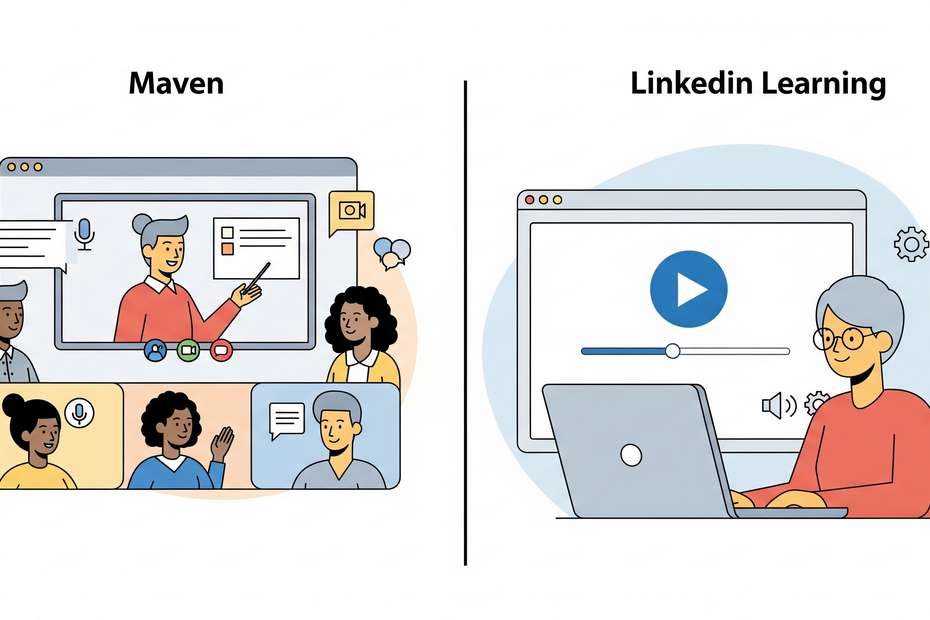
LinkedIn Learning accelerates growth faster if your goal is breadth of skills and employer-recognized credentials, while Maven accelerates growth faster if you want deep, interactive, community-driven learning.
In this article, you’ll get a side-by-side comparison of Maven and LinkedIn Learning: what each platform does best, what learners report, cost vs return, and how to align the right choice with your career goals. By the end, you’ll know which option delivers the growth velocity you need.
What is the core difference between Maven and LinkedIn Learning?
Maven operates on a cohort-based learning model with structured schedules, live sessions, and peer interactions. LinkedIn Learning delivers on-demand video courses with full flexibility and a vast catalog.
With Maven, you commit to live classes, assignments, and deadlines. This creates accountability and deeper engagement but requires you to manage fixed schedules. LinkedIn Learning, by contrast, allows you to start and stop at any time, making it suitable for busy professionals with unpredictable calendars.
Your choice depends on learning style: if you thrive with structure, Maven accelerates growth by pushing you harder. If flexibility matters most, LinkedIn Learning fits better.
How do costs and pricing models compare?
Maven is premium-priced. Courses typically range from $300 to $1,000, reflecting instructor involvement, peer groups, and project-based learning. You pay per course, and each runs for a set duration.
LinkedIn Learning uses a subscription model—around $19.99 to $39.99 per month, or a discounted annual plan. That gives you unlimited access to more than 10,000 courses spanning business, technology, and creative skills.
The trade-off: Maven provides high-touch learning at a higher cost per course, while LinkedIn Learning offers affordability and scale, but with less personal interaction.
What outcomes do learners report from each platform?
Maven learners often emphasize transformation through peer feedback, instructor interaction, and networking. The cohort format forces application of lessons, which leads to stronger retention. Professionals in leadership, entrepreneurship, or specialized fields often highlight Maven’s effectiveness in accelerating mastery.
LinkedIn Learning learners report rapid breadth of skill acquisition, useful for filling immediate knowledge gaps. Many appreciate that certificates integrate directly with LinkedIn profiles, making achievements visible to employers and recruiters. This visibility translates into career credibility and sometimes direct job opportunities.
If you’re pursuing niche skills or leadership development, Maven’s depth works best. If you need multiple skills quickly to stay competitive, LinkedIn Learning scales better.
How does employer recognition differ between the two platforms?
LinkedIn Learning enjoys stronger employer recognition because it’s embedded in the LinkedIn ecosystem. Certificates display on your profile, boosting visibility and credibility in job searches. Recruiters and hiring managers recognize the LinkedIn brand, giving added weight to your learning.
Maven’s certificates carry less institutional weight. Instead, the reputation of the instructor and the community you join provide credibility. For instance, if you take a Maven course taught by a recognized industry leader, peers and employers in that niche may value it highly.
In mainstream corporate settings, LinkedIn Learning is better for recognized credentials. In specialized or entrepreneurial circles, Maven’s credibility through instructors can matter more.
Which platform fits better into your schedule?
LinkedIn Learning offers full flexibility. You can take courses at your own pace, pause them, or study offline through mobile apps. This works well for part-time learners, professionals with unpredictable hours, or anyone balancing multiple commitments.
Maven demands commitment to a set schedule. You attend live sessions, complete assignments, and participate in discussions at specific times. While this reduces flexibility, it increases accountability and accelerates results by keeping you on track.
If your schedule is unpredictable, LinkedIn Learning is safer. If you want structured discipline that forces growth, Maven’s calendar-based cohorts may accelerate your progress more.
What features accelerate growth differently on each platform?
Each platform includes growth accelerators, but they differ in style and execution:
- Maven: live instructor feedback, project-based assignments, group collaboration, accountability deadlines, peer networking.
- LinkedIn Learning: vast catalog, learning paths, algorithm-driven recommendations, LinkedIn profile integration, mobile-friendly access.
On Maven, growth comes from community accountability and applied practice. On LinkedIn Learning, growth comes from speed, scale, and professional visibility through credential integration.
What type of learner benefits most from Maven?
Maven is ideal for learners who:
- Thrive in interactive, social environments.
- Value direct instructor access and feedback.
- Want to build professional networks alongside learning.
- Prefer accountability through structure and deadlines.
- Are willing to pay a premium for depth and transformation.
If you’re looking for meaningful change in leadership, entrepreneurship, or specialized fields, Maven accelerates growth by immersing you in guided, live, applied learning.
What type of learner benefits most from LinkedIn Learning?
LinkedIn Learning is best for learners who:
- Need broad skill acquisition across multiple topics.
- Value low-cost, unlimited access to courses.
- Want certificates recognized by employers and visible on LinkedIn.
- Prefer self-paced learning with no time constraints.
- Use learning as part of ongoing professional development or career transition.
If you want scalable skill growth and credentials that enhance your professional profile, LinkedIn Learning delivers faster outcomes.
What are the trade-offs and risks with each platform?
Maven’s risk is higher cost and fixed schedules. If the instructor quality or cohort experience doesn’t meet expectations, the return on investment may feel limited.
LinkedIn Learning’s risk is shallowness and lack of accountability. You may accumulate certificates without mastering skills or applying them effectively. Without discipline, the growth impact can be minimal.
You can balance these risks by using LinkedIn Learning for foundational skills and Maven for deeper, specialized mastery.
Which is faster: Maven vs LinkedIn Learning?
- LinkedIn Learning accelerates breadth of skills and recognition.
- Maven accelerates depth, accountability, and mastery.
- Choose based on your goals: variety vs specialization, flexibility vs structure.
In Conclusion
Maven and LinkedIn Learning both accelerate growth—but in different ways. Maven excels at deep, structured, and community-driven learning that transforms how you work in niche areas. LinkedIn Learning excels at breadth, affordability, and employer recognition, making it the better choice for quickly building multiple skills and enhancing professional visibility. The fastest platform for you depends on your career goals, time, budget, and learning style.

Chrysilios Chrysiliou is a commercial real estate executive at RDPH Properties, Inc. with a diverse background in aviation and entrepreneurship. A former Greek Air Force Academy graduate, flight instructor, and flight school co-owner, he now leverages decades of strategic leadership to identify and develop high-value real estate opportunities.