
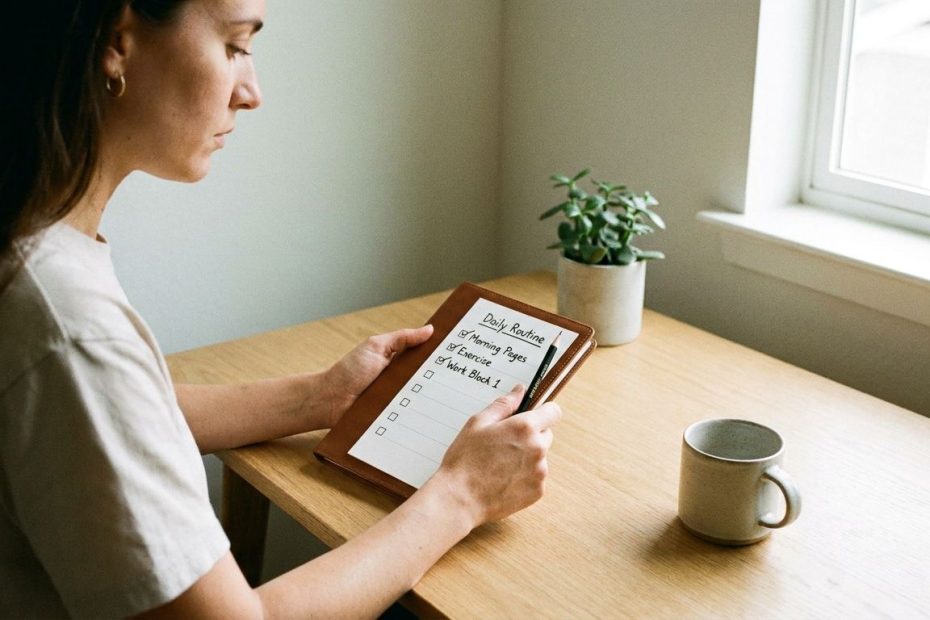
Motivation changes with your mood, but self-discipline gives you a repeatable way to act after the excitement fades.
If you’re tired of starting strong and stopping soon after, the problem usually isn’t laziness. It’s that motivation is too unstable to carry long-term goals by itself. This article shows why self-discipline works better, how habit research supports it, and how you can build discipline without turning your life into a joyless grind.
The Fleeting High Of Motivation And Why It Fails You
Motivation feels useful because it gives you energy fast. You read a book, watch a talk, set a goal, clean your desk, buy the planner, and feel ready to change your life. That emotional lift can help you begin, but it rarely survives boredom, stress, poor sleep, slow progress, or a crowded schedule. Once the novelty wears off, the task still has to get done.
That’s why motivation often turns into a trap for procrastination. You tell yourself you’ll work out when you feel inspired, write when the mood returns, or start saving when life calms down. The condition keeps moving. Self-discipline removes that loophole by connecting action to a decision, not a feeling.
Resolution research also points to the same pattern: many people set goals with strong emotion at the start, but only a small share report achieving them. The common failure point is not always bad goals. It’s the missing routine, reminder, environment, and follow-through system that carries behavior after the original excitement disappears.
Self-Discipline Defined: More Than Just Willpower
Self-discipline is the ability to do what you already decided to do when your mood doesn’t cooperate. It doesn’t mean you never feel resistance. It means resistance no longer gets full control over your schedule, health, money, learning, or work.
Willpower is part of self-discipline, but it isn’t the whole thing. Willpower helps you resist an urge in the moment. Self-discipline includes planning, routines, environment design, repetition, recovery, and the ability to restart after a missed day. That wider skill set makes discipline more reliable than raw effort.
Think of motivation as a thermostat and discipline as insulation. Motivation can raise your energy quickly, but it leaks away when life gets uncomfortable. Discipline keeps the system working because you’ve built cues, routines, and standards that don’t depend on emotional temperature.
The Science That Shows Discipline Wins
Research on self-control has repeatedly linked disciplined behavior with stronger outcomes. In work by Angela Duckworth and Martin Seligman, self-discipline predicted academic performance better than intelligence quotient in adolescents. That matters because it shifts the focus away from talent alone and toward daily behavior you can train.
Walter Mischel’s delayed gratification work added another piece. Children who could wait for a later reward often showed better outcomes later in life, including educational markers and health-related measures. Later research has added more caution around how those findings are interpreted, but the core lesson still helps: the strategies you use to manage impulse matter.
Habit research makes the argument practical. Phillippa Lally and colleagues found that new behaviors become more automatic through repeated performance in stable settings. The average time reported in that study was 66 days, but the larger point is more useful than the number: consistency, not emotional intensity, turns action into routine.
Why Discipline Is Sustainable And Motivation Is A Trap
Motivation asks you to keep refueling your emotions. Discipline reduces the need for emotional fuel by making the right action easier to repeat. Once a behavior becomes tied to a cue, it takes less debate to begin. You don’t negotiate with yourself for an hour; you follow the next step.
This matters because decision-making burns attention. If every workout, study session, budget review, or writing block requires a fresh internal speech, you’ll lose energy before the real work starts. A routine protects you from that constant negotiation. It gives your brain fewer doors to wander through.
Self-discipline also creates self-trust. Each completed action becomes evidence that you can follow through without perfect conditions. That confidence is quieter than motivation, but it’s steadier. You stop chasing a better mood and start relying on a better system.
Build Your Discipline Muscle With Small Reps
Self-discipline grows best when the starting point is small enough to repeat. A five-minute walk, one cleared surface, one page of reading, or one scheduled savings review may look too modest at first. That modest size is the point. You’re training the follow-through reflex before you raise the load.
Use simple if-then plans to remove hesitation. If it’s 7:00 in the morning, you put on your shoes. If you close your laptop for lunch, you take a short walk. If you finish dinner, you prepare tomorrow’s first task. The clearer the cue, the less you depend on mood.
Environment design makes discipline easier too. Put the book on your pillow, keep workout clothes visible, block distracting sites during work blocks, move snacks out of immediate reach, or place your budget app where you’ll see it. Good discipline is not constant inner combat. It’s the careful removal of avoidable friction.
Overcome The “I’m Not A Disciplined Person” Myth
You don’t need to be born disciplined to become disciplined. Self-control research has often used the muscle metaphor because disciplined action can fatigue in the short term yet improve with practice. That doesn’t mean you should force yourself through endless strain. It means you train capacity with repeatable, controlled effort.
The myth of the “disciplined person” hurts progress because it turns behavior into identity too early. If you miss two workouts, you label yourself undisciplined. If you delay one project, you call yourself lazy. Those labels don’t build skill; they drain effort before you return to the routine.
Replace identity judgment with behavior review. Ask what cue failed, what friction was too high, what time slot was unrealistic, or what reminder was missing. That keeps the problem solvable. You’re not fixing your character; you’re improving the system that supports your choices.
Use Motivation As A Spark, Not The Engine
Motivation still has a place. It can help you choose a direction, start a new habit, reconnect with a value, or make the first move when you’ve been stuck. The mistake is asking motivation to do the daily work that only structure can handle.
A useful goal often begins with desire. You want better health, cleaner finances, stronger focus, deeper learning, or more reliable output. Desire gives the goal meaning. Discipline turns that meaning into calendar blocks, cues, checklists, practice, repetition, and honest review.
When motivation returns, use it well. Plan the routine, prepare the environment, schedule the next action, and make the desired behavior easier to repeat later. Don’t spend the whole burst consuming more inspiration. Convert the spark into a system before it fades.
Prevent Burnout By Making Discipline Humane
Many people reject self-discipline because they confuse it with punishment. Real discipline is not skipping rest, ignoring limits, or forcing maximum effort every day. That version breaks down fast. Better discipline protects your energy so the routine can last.
Build recovery into the plan before you need it. Set a minimum version of the habit for hard days, plan breaks, and avoid stacking too many changes at once. A minimum version keeps the chain alive without pretending every day will be ideal. Reading one page still supports the reading habit; walking for five minutes still supports the movement habit.
You also need standards that allow repair. Missing one day should trigger a return plan, not a spiral. The goal is not flawless performance. The goal is fast recovery, fewer negotiations, and steady alignment between what you said you’d do and what you actually do.
How To Develop Self-Discipline In Daily Life
Start with one behavior that matters and make it concrete. “Get healthier” is too vague. “Walk for ten minutes after breakfast” is usable. “Be more productive” is too broad. “Work on the main task for 25 minutes before checking messages” gives you a clear action.
Track completion, not emotion. You don’t need to record whether you felt ready. Record whether the action happened. That simple shift teaches you that feelings are weather, not instructions. Over time, the visible record gives you feedback without drama.
Review weekly and adjust the setup. If the habit failed four times, shrink it, move it, attach it to a stronger cue, or reduce friction. If it worked easily, keep repeating it before raising the difficulty. Self-discipline beats motivation every time because it improves through feedback, not fantasy.
Why Does Self-Discipline Beat Motivation?
- Motivation fades when tasks get boring.
- Self-discipline builds repeatable habits.
- Habits reduce daily decision strain.
- Discipline creates steady progress.
Build The System That Carries You Forward
Self-discipline wins because it gives you a dependable way to act when motivation disappears. You still get to use motivation when it shows up, but you stop waiting for it to run your life. The practical move is simple: choose one behavior, attach it to a clear cue, lower the friction, track completion, and review the system without attacking yourself. That’s how you turn self-discipline from a harsh idea into a trainable skill. When you stop chasing feelings and start building routines, progress becomes less dramatic and far more reliable.
References
- Baumeister, R. F., et al. — Ego Depletion: Is The Active Self A Limited Resource?
- Hagger, M. S., et al. — Ego Depletion And The Strength Model Of Self-Control
- Mischel, W., Shoda, Y., And Rodriguez, M. L. — Delay Of Gratification In Children
- Lally, P., van Jaarsveld, C. H. M., Potts, H. W. W., And Wardle, J. — How Are Habits Formed?
- Duckworth, A. L., And Seligman, M. E. P. — Self-Discipline Outdoes Intelligence Quotient In Predicting Academic Performance Of Adolescents
- Duckworth, A. L., et al. — Self-Control And Grit: Related But Separable Determinants Of Success
- American Psychological Association — Willpower
- Harvard Business Review — The Power Of Small Wins
- Time — Why Self-Discipline Is Overrated
- Archived Resolution Statistics Summary

Chrysilios Chrysiliou is a commercial real estate executive at RDPH Properties, Inc. with a diverse background in aviation and entrepreneurship. A former Greek Air Force Academy graduate, flight instructor, and flight school co-owner, he now leverages decades of strategic leadership to identify and develop high-value real estate opportunities.