
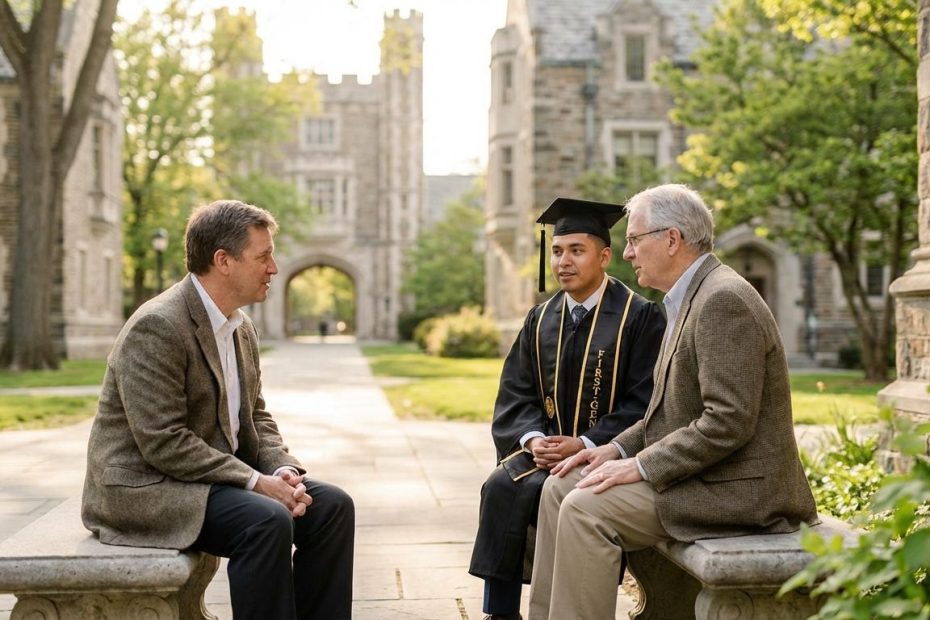
First-gen success stories disrupt the narrative because they expose a simple truth: the biggest barrier often isn’t ability, it’s access to the unwritten rules, financial runway, and referral networks that convert talent into outcomes.
You can use that truth to make better choices, earlier, and with fewer expensive detours. This article breaks down what “first-gen” really means, why the hidden curriculum keeps showing up in real student advice, what the economic data says after graduation, and what to execute if the goal is not just admission, but stability and upward mobility.
What Counts As “First-Generation,” And Why Are So Many People Confused About It?
“First-generation” sounds like a clean label until it hits real life. Many colleges and programs define first-gen as having parent(s) who did not complete a four-year degree, yet definitions differ across scholarships, TRIO-style support programs, institutions, and state initiatives. That mismatch creates confusion that continuing-generation students rarely have to solve on their own.
Where the confusion becomes costly is timing. If a program defines first-gen as “no parent has a bachelor’s degree,” and another uses “neither parent attended college,” the same student can qualify for one set of benefits and miss another. That can change eligibility for cohort programs, scholarship consideration, fee waivers, mentoring, summer bridge, and priority advising, which are the exact supports that reduce dropout risk.
You also see edge cases everywhere: a parent with an associate degree, a degree earned outside the U.S., a parent who is absent, guardians who raised you, or a parent who completed a degree later in life. Online student communities repeatedly ask these questions because schools rarely explain the definition in plain language during the moments that matter: college list building, application season, and financial aid packaging.
The operational move is simple. Treat “first-gen” like a compliance item, not an identity debate. Read each program’s definition, save a screenshot or PDF, then email the coordinator with a two-sentence description of the family education situation and ask for a written eligibility confirmation. That paper trail prevents last-minute surprises when a scholarship office reviews documentation.
Are First-Gen Students Actually Doing Better Than People Think, Or Is It Just A Few Viral Success Stories?
First-gen students are not “doing better than people think” in the aggregate if the yardstick is completion speed and completion rates. Many are battling a stacked schedule of work hours, commute time, family obligations, and inconsistent advising, which raises the odds of stopping out. The success stories go viral because they are earned under constraints that never show up in a glossy acceptance post.
Completion gaps show up in national reporting and in first-gen advocacy fact sheets. FirstGen Forward’s fact sheet work (produced with RTI International) has highlighted a six-year bachelor’s completion gap between first-generation and continuing-generation students, a gap that makes every completion story feel disruptive because it contradicts the idea that outcomes are purely merit-based. When that gap narrows on a campus, it usually tracks back to concrete supports: proactive advising, emergency aid, predictable course maps, and programs that make the hidden curriculum visible.
You also have to separate “visibility” from “volume.” More first-gen students are sharing wins publicly, and many schools now celebrate first-gen graduates in ways they did not a decade ago. That is progress in narrative and belonging, yet visibility does not automatically mean the system has improved enough to turn access into completion at scale.
If the goal is to become one of the success stories without relying on luck, stop treating support programs as optional. Join the first-gen center, TRIO-type advising, learning communities, or scholarship cohorts early, then use them like a performance system: scheduled check-ins, documented academic plans, internship timelines, and financial aid follow-through.
What’s The “Hidden Curriculum,” And Why Do First-Gen Success Stories Keep Mentioning It?
The hidden curriculum is the set of unwritten rules that determine whether a student converts effort into opportunity. It covers how office hours work, how to ask for letters of recommendation, how to appeal a financial aid decision, how to get into research, how to win internships without a family referral network, and how to pick classes that keep graduation on time. Many students arrive with the ability to do college-level work, yet without the process knowledge to navigate the system efficiently.
Higher-ed teaching and learning work has described how first-gen students can arrive with incorrect information about the college-going process, and how that shows up in classrooms and faculty-student interaction. Faculty and staff often assume students know how to self-advocate, interpret a syllabus, or use campus resources, then interpret silence as disinterest. What you are seeing is not a motivation gap, it’s a translation problem.
Campus leaders who treat the hidden curriculum seriously translate “common knowledge” into explicit instruction. CSU Fullerton’s coverage of the hidden curriculum has emphasized that students can miss key information and opportunities because expectations are not made visible, and that helping students decode those expectations improves access to benefits already sitting on campus. This is why first-gen success stories keep naming mentors, advisors, and a single staff member who explained the rules at the right moment.
The playbook is practical. You build a personal operating system that covers: how to communicate with professors, how to track deadlines, how to use office hours, how to secure work-study that aligns with career goals, how to obtain tutoring early, and how to document every administrative interaction. When this gets executed well, “first-gen grit” stops being a slogan and becomes an advantage built on process discipline.
Why Do First-Gen Grads Still Lag Financially Even After Earning The Same Degree?
Even when you earn the same credential, you do not start adulthood with the same balance sheet. Pew Research Center’s May 18, 2021 analysis shows that among households headed by college graduates, those without a college-educated parent have lower incomes and less wealth on average than those with a parent who has a bachelor’s degree or higher. Pew also reports that first-generation college graduates are more likely to carry education debt and often have higher outstanding balances.
Pew’s numbers are blunt, and that is helpful. In the 2019 Federal Reserve data used in the analysis, Pew reports median household income of $99,600 for households headed by a first-generation college graduate versus $135,800 for households headed by a second-generation graduate. Pew also reports median wealth of $152,000 for households headed by a first-generation graduate versus $244,500 for households headed by a second-generation graduate. Those gaps are not about intelligence, they trace back to family resources, inheritances, the ability to take unpaid internships, and the ability to absorb shocks without borrowing.
That reality changes how to plan your degree path. If you have less family runway, you need tighter execution on time-to-degree, lower error rates in course selection, early internships that convert into return offers, and a realistic plan for debt. Financial outcomes respond to operational choices, yet those choices require information that often sits inside the hidden curriculum.
Start treating money as a graduation requirement. Track your net cost each term, know the difference between grants and loans, measure expected debt at graduation, and map your first post-grad job options to actual salaries in your field. A first-gen win is not only a diploma, it is a diploma that does not trap you in avoidable repayment stress.
What Do First-Gen Students Say They Need Most: Money, Mentors, Or Mental Health Support?
In real student advice threads, the recurring theme is navigation support backed by real resources. Students talk about FAFSA execution, tutoring, office hours, choosing classes strategically, finding peers who understand the pressure, and getting an advisor who will answer tactical questions without judgment. Money matters, but money without navigation still leads to wasted credits, missed deadlines, and delayed graduation.
On Reddit, first-gen students and staff who work with first-gen populations repeatedly point to structured support: supplemental advising, free tutors, FAFSA help, transfer support, application fee waivers, and campus programs that keep students from solving every problem alone. That aligns with what many colleges already know: the best supports reduce friction at the exact moments students tend to stop out, including financial aid verification, course registration bottlenecks, and major selection.
Mentorship also functions as a force multiplier. A mentor can turn a vague plan into a calendar, and a calendar into outcomes. You need at least one staff or faculty contact who will say, plainly, “Here is what to do this week,” then hold you to it, and you also need peer support that keeps you from normalizing burnout.
If prioritization is required, choose supports that reduce irreversible damage. That means financial aid completion, course planning to prevent excess credits, tutoring before grades collapse, and an internship search plan early enough to avoid panic applications. Mental health support matters too, and it becomes more accessible when the rest of the system stops generating preventable crises.
What’s Changing Right Now That’s Making First-Gen Success Stories More Visible?
First-gen visibility has increased because schools, states, and employers have started treating first-gen status as a real student success variable, not a personal detail. More campuses now run first-gen celebrations, peer mentoring, and targeted advising, which moves success stories from private wins to public recognition. When people see someone “like them” in a cap and gown photo, it changes what feels realistic.
Media and higher-ed coverage also increasingly avoids treating first-gen students as a monolith. Coverage focuses on strengths that show up under pressure: adaptability, persistence, practical problem-solving, and the ability to navigate unfamiliar systems. That strengths-based recognition does not erase structural barriers, yet it does change how students interpret their own experience and whether they seek help early.
Higher education reporting in 2025 has also emphasized resilience and student voice, highlighting that student stories matter alongside institutional strategy. When student voice is elevated, administrators hear where processes break, and that feedback can translate into policy changes that reduce friction for the next cohort. That is how narrative disruption becomes systems disruption.
You can leverage this moment by opting into visibility with intent. Share milestones with first-gen programs, apply for first-gen scholarships even if you assume competition is intense, and ask for leadership roles in peer mentoring. Visibility turns into opportunity when the right offices know who you are before the internship season starts.
What’s The Hidden Curriculum For First-Gen Students?
- Unwritten college rules: office hours, advising, financial aid steps, networking
- Access points: research, internships, referrals, course planning
- Success move: make it explicit, then execute it on a calendar
Build Your Own Advantage From Here
You disrupt the narrative by refusing to treat uncertainty as normal. Lock down the definition of first-gen for every program that matters, then claim the supports tied to that status. Translate the hidden curriculum into a repeatable operating system that covers academics, administration, internships, and money. Use the data as motivation to reduce avoidable debt and protect time-to-degree, since post-grad income and wealth gaps are real and measurable. Then stay visible, stay connected to the people who control opportunities, and convert support into outcomes that last.
References
- Pew Research Center (May 18, 2021): First-Generation College Graduates Lag Behind Their Peers on Key Economic Outcomes
- FirstGen Forward: Fact Sheets (RTI International collaboration)
- Innovations in Teaching & Learning Conference Proceedings (2019): First Generation Students and the Hidden Curriculum
- CSUF News (Aug 2017): Educator Reveals the Importance of the Hidden Curriculum
- Inside Higher Ed (Aug 6, 2025): The Resilience of First-Generation Students
- PR Newswire: Illuminating the Hidden Curriculum for First-Generation Students
- Reddit r/ApplyingToCollege: First-gen college advice thread
- Reddit r/college: Advice for first generation college students thread

Chrysilios Chrysiliou is a commercial real estate executive at RDPH Properties, Inc. with a diverse background in aviation and entrepreneurship. A former Greek Air Force Academy graduate, flight instructor, and flight school co-owner, he now leverages decades of strategic leadership to identify and develop high-value real estate opportunities.